Chart your market data estate.
Every subscription, contract, entitlement and licence obligation in your market data estate, in one defensible view, with an assistant that knows the domain.
Few buy-side firms have a clear view of their market data spend. Fewer still know what their estate exposes them to.
Market data is one of the least visible things on the desk. The contracts are opaque by design, the usage policies live on vendor and exchange websites rather than in the contract, and the knowledge usually lives in one person’s head or a sprawl of spreadsheets. The spend picture is usually incomplete. The exposure picture is worse, because nobody has been asked to look.
Licences that don’t match the use.
A screen licence ends up feeding a model, a client report or an application. Each is a different licence, and the vendor’s contract says checking that is your job.
Rules that change without a signature.
Your contract often points to a usage policy on the vendor or exchange website. They can change it and nothing tells you it has, until they audit.
Audits you can’t evidence.
Vendor and exchange audits are settled on paperwork. If inventory, entitlements and contracts don’t reconcile, the exposure is backdated to whenever the vendor says it started.
Renewals that happen to you.
The critical date isn’t the contract end, it’s the notice deadline. Miss it and you’re locked in for another term, on the vendor’s terms.
Why nothing on the market fixes this.
Vendors write the rules.
Vendors and exchanges sell data, and their contracts point to policies they control. A tool that checks your usage against those policies, and catches auto-renewals, works directly against their commercial interest.
Enterprise tools target tier-one banks.
The incumbent platforms are built for institutions with 500+ users and six-figure implementation budgets. The APAC mid-market buy-side is unserved, and carrying the same exposures with none of the cover.
The knowledge is scarce.
Knowing where market data exposure hides, permissioning hierarchies, per-terminal contracts, display versus non-display, derived data policy, what an exchange audit actually looks like, takes decades in the function that most software teams don’t have. Compass was built by someone who has them.
Six functions, one defensible record.
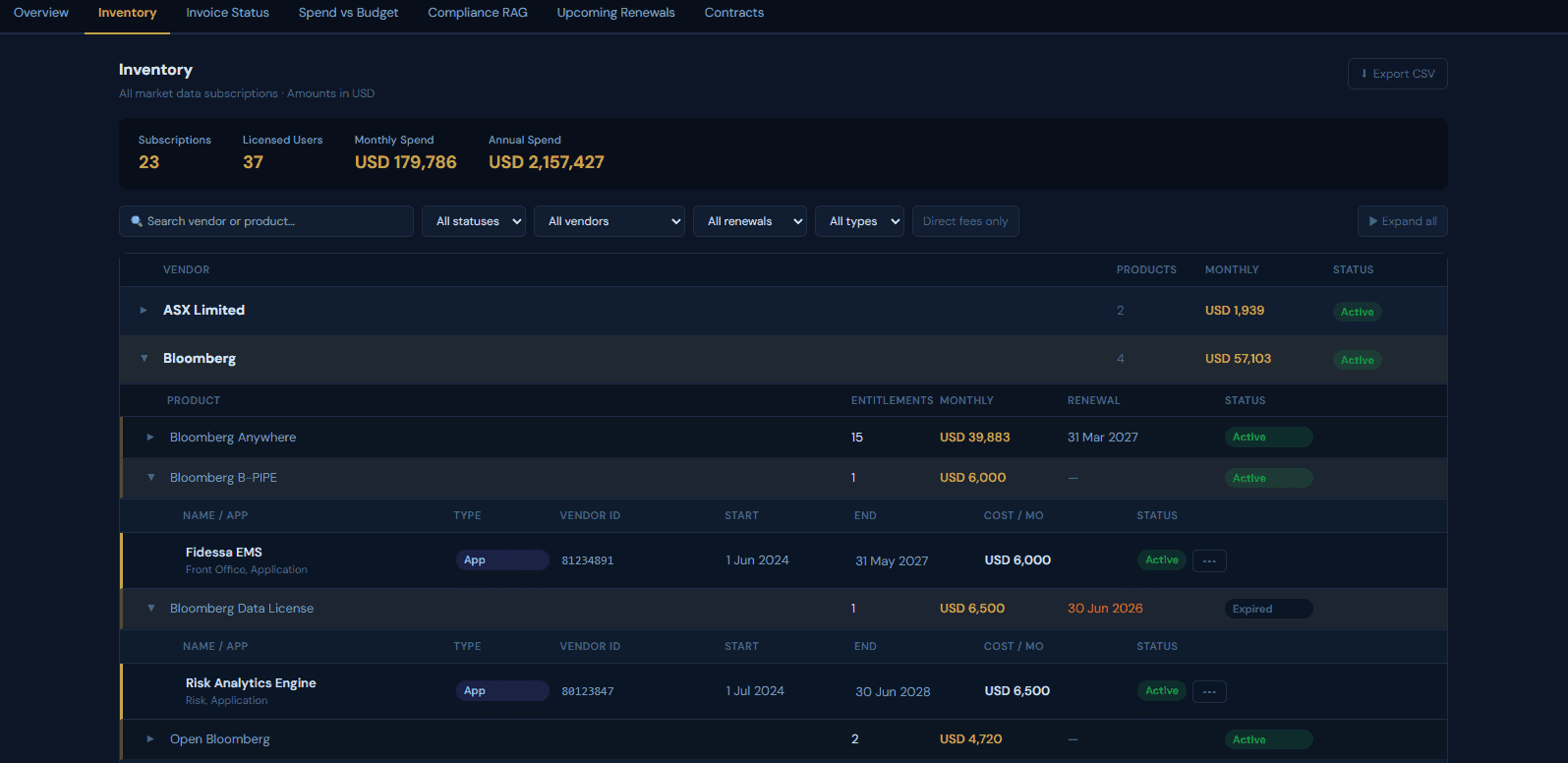
Inventory
Every subscription and entitlement in one live view: who uses it, what for, and which licence covers it.
Built to model market data correctly.
Generic spend-management tools treat market data like any other vendor line. That is exactly where the exposure hides. Compass models the structures major vendor contracts are built on: the detail that determines what you’re actually licensed for and where you’re exposed.
Vendor contract hierarchies
LSEG’s RMA, Schedule and Order Form structure and Bloomberg’s per-terminal contracts, each with its own dates and notice window, modelled as they really are.
Child subscriptions
Exchange fees, news feeds and add-on data modelled beneath each entitlement, with their own billing type, vendor and lifecycle. Compass knows which survive a cancellation and which do not.
User and application entitlements
A trader’s terminal and an algo engine’s data feed are commercially different things. Compass models both, so per-user seats and per-application licences are tracked correctly. It has to, because the audit will.
Notice-deadline logic
Every contract’s true decision date, the end date minus its notice period, is tracked and surfaced, so renewals are a choice, not an accident.
Not a chatbot bolted on the side.
The Compass Assistant sits inside the workflow with direct access to the data model. It answers operational questions in plain language because it understands the domain.
Question: Do we have any entitlement compliance gaps right now? Answer: Yes. One red, one amber. Red: the latest usage review shows SGX data from LSEG DataScope Select feeding a non-display application, and there is no non-display licence in place with SGX. The application went live last month. That is usage without a licence, so SGX should be engaged now to put the right licensing in place. Left alone, it becomes a backdated audit finding with a start date. Amber: FactSet Research Workstation is two seats from its cap. Not urgent, but worth closing before the next renewal conversation.
Illustrative. Demo data shown.
Two ways to engage.
For firms with someone running the market data function in-house.
Full access for your team, with AI-assisted compliance and renewal tracking. We onboard, import your data, and keep it current. You operate it.
We run the function for you.
Your outsourced market data function: vendor management, renewals, invoice verification and compliance. Everything in Compass, included. You retain every decision, and the evidence stays yours.
Why Sprada.
Nothing to sell you but the truth about your estate.
Sprada has no market data product and takes nothing from vendors. We don’t win when you buy more data.
Thirty years in the function.
Built by someone who ran market data at global and regional banks, sat on the receiving end of exchange and vendor audits, and found these exposures the hard way.
Built for APAC
SGX, HKEX, ASX, regional exchange fees and local currency, built for how this region works.
Vendor-agnostic
Bloomberg, LSEG, FactSet, ICE and exchange fees in one consistent view, with no vendor bias.
See what it finds in a realistic inventory.
Compass demonstrates best against a real situation. A 45-minute walkthrough is usually enough to know whether it fits your firm.